Hey everyone, if you’ve ever built a high-performance PC, ran a server rack 24/7, or even tinkered with a gaming setup that gets so hot you swear it’s about to blast off, you’ve probably heard of liquid cooling. But today, we’re diving into the unsung hero of most liquid cooling setups: the liquid cooling manifold. And since I run a company that makes these bad boys, I’m gonna keep this real—no stuffy engineering jargon, just what actually happens, why it matters, and why our manifolds are the real deal for anyone who needs solid thermal performance. Liquid Cooling Manifold
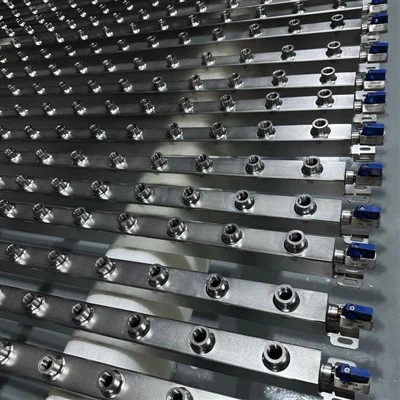
First off, let’s cut to the chase. What even is a liquid cooling manifold? Think of it as the traffic controller for your cooling fluid. Instead of a bunch of messy tubes sloshing coolant all over your setup, the manifold is that central part that moves liquid exactly where it needs to go, keeps pressure balanced, and prevents leaks. Sounds simple, right? But get this—most people skip over how critical that “simple” part is until their whole rig overheats because a tube got kinked or pressure was all out of whack. I’ve seen it happen so many times, so trust me when I say this isn’t just a random plastic block we sell. It’s the backbone of a reliable liquid cooling system.
Let’s break down how it actually works, step by step. No fancy equations, I promise. First, there’s the inlet and outlet ports. That’s where your main liquid line hooks up, right? Coolant (usually something like a mix of deionized water and antifreeze, no tap water—trust me, the mineral buildup is a nightmare) comes in through the inlet. The manifold’s job right here is to split that single stream of coolant into smaller, even streams that go to each of your hot components—CPUs, GPUs, server chips, whatever you’re cooling. But it doesn’t just split willy-nilly. We engineer our manifolds with internal channels that are sized and shaped to make sure every component gets the same amount of flow. If one chip gets more coolant than the other, that chip will run hotter. So we test every design until the flow rate is dead even across all ports. That’s the part a lot of cheap manifolds skip, and it’s why they fail.
Next up, pressure regulation and flow control. Coolant moves through the system thanks to a pump, but too much or too little pressure can cause leaks, damage your components, or just waste energy. Our manifolds have built-in features—some have tiny pressure check valves, others have flow restrictors that are calibrated to match the needs of each component. For example, a high-power GPU might need a higher flow rate than a smaller M.2 drive, so we adjust the internal channels to make that happen without cranking up the pump so loud it sounds like a jet engine. No one wants their gaming setup to double as a lawnmower, right?
Then there’s heat transfer. Wait, hold on—does the manifold itself transfer heat? Yeah, actually, when it’s designed right. Most manifolds are made from aluminum or copper, metals that conduct heat really well. So as the hot coolant flows through the internal channels, the manifold’s material soaks up any extra heat from the component it’s mounted on, sends that heat to the coolant, and then the coolant carries it away to the radiator. It’s a two-for-one deal: you’ve got the traffic control, plus a little extra thermal headroom. That’s something we prioritize in our designs—we don’t just make a plastic block with holes in it; we make a thermal conductor that does its job without being a bottleneck.
Leak prevention is the big one, too. I can’t stress this enough. A leak in your cooling system can ruin a $2,000 GPU faster than you can say “oops.” Our manifolds are precision-machined, so every port fits the tubing or connectors exactly, no gaps. We use O-rings that are rated for high pressure and temperature, and we pressure-test every single manifold that leaves our warehouse. I’ve had customers come to us after buying a cheap manifold from a no-name brand that started leaking after a week, and they had to replace half their server setup. That’s why we don’t cut corners on quality—your parts are expensive, our manifolds should protect them, not cause problems.
Now, let’s talk about where these things get used, because it’s not just gaming PCs. We make manifolds for data centers, industrial machinery, EV batteries, even medical devices. Data centers are the biggest use case for us right now. Those racks full of servers generate so much heat that air cooling just doesn’t cut it anymore. A single server rack can draw 10kW of power, and all that power turns to heat. Liquid cooling manifolds split the coolant to every server in the rack, keep flow consistent, and make sure every component stays at its optimal temperature. If a server overheats, it goes down, and data centers can’t afford downtime—every minute of downtime costs them thousands. That’s why our manifolds are built to run 24/7, 365 days a year, no failures.
Wait, let’s address a common misconception. Some people think “why not just use bare tubes?” Yeah, you can, but that’s messy, hard to install, and easy to mess up. Manifolds make installations way faster. If you’re building a data center with 100 racks, using manifolds means you hook up one main line to each rack, instead of 10 separate lines to each server. That cuts installation time by half, less room for human error. For gaming PCs, if you’re a builder, a manifold means one central hub instead of 5 different tubes running all over your case—way cleaner, way easier to maintain when you need to swap a part.
Let me give you a quick example of a recent project we did. We worked with a startup that was building a new line of high-performance workstations for video editing and 3D rendering. Their old air cooling setups were making their workstations so loud that editors couldn’t hear audio while editing. We designed custom manifolds for their CPUs and GPUs, balanced the flow so every component stayed cool, and let them downsize their pumps. Now their workstations run quiet enough to use in a regular office, and they don’t overheat when rendering a 4K video. That’s the kind of impact a good manifold makes—it’s not just a part, it solves real problems for our customers.
Now, why choose our manifolds over others? I’m not here to brag, but I’m here to be honest. A lot of suppliers copy designs and cut costs on materials or testing. We design every manifold in-house, test for flow rate, pressure, temperature, and leak resistance before it even leaves our facility. We work with customers to customize manifolds if they have unique needs—whether you need a custom number of ports, a specific material for your application, or something that fits a tight space. We know every setup is different, so our manifolds shouldn’t be one-size-fits-all.
If you’re reading this, chances are you’re either building a new cooling system, having problems with your current one, or just curious how all this tech works. If you’re in the market for a liquid cooling manifold, don’t just go for the cheapest option. Ask about flow balance, leak testing, material quality, and customization options. Those are the things that separate a part that works and a part that causes you headaches.
At the end of the day, a liquid cooling manifold might seem like a small, un exciting part, but it’s the glue that holds the whole system together. Without it, coolant isn’t delivered evenly, pressure fluctuates, leaks happen, and your setup overheats. We’ve spent years perfecting our manifolds to fix those exact problems, and we’re here to help anyone—whether you’re a PC builder, a data center operator, or an industrial engineer—find the right solution for your needs.

If you’re ready to talk about your project, need a custom quote, or just have questions about how our manifolds can work for you, reach out to our team to connect for procurement talks. We’re here to make sure your liquid cooling system works as hard as you do.
Straight Stainless Steel Tube References
- ASHRAE Handbook: HVAC Applications, Chapter 20—Data Centers, 2023
- Cooling Technology Institute. Liquid Cooling for Electronic Equipment: Design and Application Guide, 2022
- International Society of Automation (ISA). Thermal Management for Industrial Electronics, 2021
- Patel, C. et al. “Thermal Performance of Liquid Cooling Manifolds for High-Density Servers.” Journal of Electronic Packaging, 2020, Vol. 142, No. 2.
China Super Tech Co., Ltd.
As one of the most professional liquid cooling manifold manufacturers and suppliers in China, we’re featured by quality products and good service. Please rest assured to wholesale OEM liquid cooling manifold from our factory. Also, custom service is available.
Address: Wangjing Science and Technology Park, Guangshun North Street, Chaoyang District, Beijing
E-mail: sales@316liquidcooling.com
WebSite: https://www.316liquidcooling.com/
