If you’ve ever walked through a workshop specializing in upholstered goods, automotive interiors, small-scale plastic part fabrication, or even inflatable products like pool floats or medical air mattresses, you’ve likely seen a piece of equipment that looks like a hybrid of a sewing station and a small industrial press: that’s a Head Foot Operated HF Welding Machine. As a supplier of these machines, I get asked all the same questions when contractors, production managers, and small business owners start looking for welding equipment for their projects. One of the most common mix-ups is between this type of HF welder and friction stir welding (FSW) machines. Folks often ask, “Can I use either for my work?” or “Why would one cost 10 times more than the other, and is it actually worth it?” Head Foot Operated HF Welding Machine
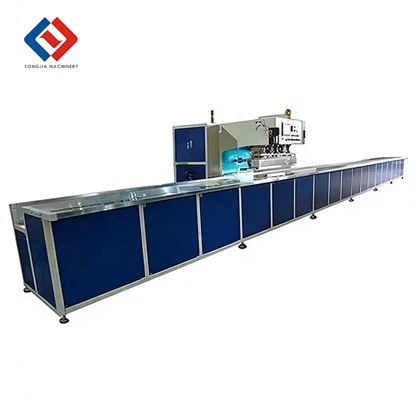
The truth is, these two machines are designed for entirely different jobs, materials, and production scales. To someone who isn’t deep in the welding equipment space, the only similarity is that they both join materials. But if you need reliable, durable welds for your specific product, mixing these two up could derail your production timeline, waste material, or even lead to products that fail before they hit the market. Let’s break this down clearly, drawing on decades of field experience from both my time working in workshops that use these machines and my work supplying Head Foot Operated HF welders to small to mid-sized manufacturers.
First, let’s start with the core technology behind each machine, because that’s where all the differences stem from.
Head Foot Operated HF Welding Machines, also called HF seat welders or pedal-operated high-frequency welders, work on the principle of dielectric heating. High-frequency radio waves are directed into two materials that have dipole molecules—meaning their molecules have a positive and negative end, like most thermoplastics and vinyls. When these molecules are exposed to the high-frequency electromagnetic field, they vibrate rapidly, generating friction and heat internally. That heat melts the thermoplastic or vinyl from the inside out, and then two flat, heated dies (custom-cut to your design) press the materials together as they cool, forming a strong, seamless weld.
What makes these machines “Head Foot Operated” is their control system: a foot pedal controls the downforce on the weld dies, while the head above the worktable houses the HF generator. This manual operation is intentional, especially for small runs or custom parts. An operator can adjust the pressure and weld speed in real time for each individual piece, which is perfect for parts that need tight, precise details. For example, if you’re welding a custom medical air mattress that needs small valve ports, or upholstering an automotive interior panel that has curved edges, you don’t want a fully automated machine that can’t adjust for slight variances in each part.
FSW machines, on the other hand, are a solid-state welding process—meaning they don’t melt the base materials at all. Instead, a rotating, non-consumable pin and shoulder tool is plunged into the edge of two workpieces, generating friction between the tool and the material, as well as between the two pieces of material, to soften the plastic (or metal, though most FSW for consumer goods is for metal or high-performance thermoplastics) without fully liquefying it. The tool moves along the joint line, mixing the softened material to create a strong, continuous weld line.
The key difference here is the state of the material during welding: HF welders melt the material to join it, while FSW keeps it in a mostly solid state. That seems like a small detail, but it changes everything about what each machine can do.
Next, let’s talk about the materials each machine works with, because that’s the biggest factor for most buyers. This is where Head Foot Operated HF welders shine, and where FSW falls flat for many small to mid-sized operations.
HF welders work exclusively with polar thermoplastics and vinyl-based materials. That includes PVC, polyurethane (PU), PET, EVA, and even some co-polymers that are common in inflatables, upholstery, signage, and flexible packaging. Think about the products you see every day: vinyl rain gear, pool liners, medical IV bags, automotive door panels covered in vinyl, promotional banners, and custom inflatable toys. All of these materials bond perfectly with HF welding. The dielectric heating process doesn’t require any additional materials, like adhesives or fillers—just the two pieces of the polar material itself. No messy prep, no curing time, no risk of adhesive failing in extreme temperatures.
Friction stir welding, by contrast, is designed for non-polar materials, most commonly metals like aluminum, copper, and magnesium, as well as high-performance thermoplastics that don’t respond well to dielectric heating. For example, if you’re manufacturing aluminum bicycle frames, aerospace components, or heavy-duty plastic parts like industrial storage tanks made from polyethylene, FSW is the go-to. But here’s the catch: FSW can’t weld vinyl, PVC, or the flexible thermoplastics that Head Foot Operated HF welders handle. Those non-polar materials don’t have dipole molecules, so they don’t generate enough heat from HF exposure to melt and bond. Trying to use an FSW machine on a vinyl automotive seat, for example, would result in no bond at all—just a scrap piece of material.
That doesn’t mean FSW is useless for plastics, though. There’s a newer variant called Friction Stir Spot Welding (FSSW) for plastics, but it’s mostly used for high-volume, rigid plastic parts, like appliance housings or automotive trim that needs heavy structural strength. Even then, FSSW can’t match the flexibility of HF welding for curved, large, or flexible parts. A Head Foot Operated HF welder can handle parts that are several feet long, have complex curves, or need small, precise welds like those for valve ports on an air mattress—something FSW machines, which are designed for linear, continuous welds, aren’t built to do.
Now, production capability and use cases, which are the most practical factors for someone choosing equipment for their business. This is where I see the biggest misconceptions.
Head Foot Operated HF Welding Machines are built for versatility, small to medium production runs, and custom work. The pedal operation means one operator can set up the machine, adjust the die for a new part design, and weld 10 to 50 parts an hour, depending on the complexity. They don’t require a huge floor space—many of our compact models fit on a standard workshop table, which is perfect for small businesses or startups that don’t have a dedicated large production line. They’re also extremely cost-effective for the jobs they do: a standard Head Foot Operated HF welder costs a fraction of even the smallest FSW machine, because the technology is simpler (though still specialized) and designed for flexible, low-to-medium volume work.
Our customers use these machines for everything from custom marine upholstery to veterinary surgical equipment bags, because they can adapt to new designs without a full reprogram or setup time. If a client comes in with a one-off order for a custom-sized promotional banner, an operator can swap out the weld die in minutes and have that banner welded the same day. For small businesses that do a mix of custom work and small batch production, that flexibility is priceless.
Friction stir welding machines, on the other hand, are built for high-volume, structural, linear welds. Most FSW machines are large, automated, and require a fixed production line—you can’t just move them to do a custom part in a corner of the workshop. They need precise tooling, specialized setup for each material and joint design, and trained technicians to operate and maintain them. A standard FSW line can cost 10 to 20 times more than a Head Foot Operated HF welder, and they’re designed to run 24/7 for large, repetitive orders, like manufacturing thousands of aluminum engine parts or industrial storage tanks. They’re not built for one-off jobs, custom designs, or flexible materials—if you need a curved, flexible weld, an FSW machine will either fail to make a strong bond or require custom tooling that adds even more cost and time.
Durability and weld quality are another big point of confusion. Many people assume that a more complex machine like FSW makes stronger welds, but that’s not always the case—it depends on the application.
HF welds from a quality Head Foot Operated HF welder are seamless, uniform, and as strong as the base material itself, when applied correctly. Because the heat is generated internally, there’s no risk of the weld being weaker than the surrounding material, as long as the die design and weld parameters (like HF frequency, pressure, and time) are set correctly. For flexible parts like inflatables or upholstery, that seamless weld is a huge benefit—it eliminates weak points that can tear, leak, or fray over time. My customers regularly tell me that their HF-welded inflatables or upholstered parts last twice as long as parts glued or sewn together, because there’s no seam to wear out.
FSW welds are extremely strong, but only for the right materials and applications. For metal parts, FSW produces a bond that’s often stronger than the original material, because the mixing process refines the grain structure of the metal at the joint. But for plastics, especially flexible thermoplastics, FSW can create welds that are brittle, especially if the tool parameters aren’t perfectly tuned. That’s why FSW is rarely used for flexible plastic parts—it creates a rigid, inflexible joint that can’t bend or stretch, so it’s prone to cracking if the part is moved or used repeatedly.
Maintenance and training are two more practical factors that people don’t always consider. As a supplier, I often work with small business owners who don’t have a dedicated maintenance team or a large training budget.
Head Foot Operated HF Welding Machines are relatively easy to maintain. They have a few key parts: the HF generator, the pedal control, the weld dies, and the power supply. Most minor issues, like adjusting the downforce on the pedal or replacing a worn die, can be done by the operator with basic training. We provide hands-on training for every customer, and most operators can master the machine in a day or two. There are no complex software updates, no precision tool calibrations that require a specialized technician, and spare parts are widely available for our models.
FSW machines require far more specialized maintenance. The rotating tool wears out over time and needs to be replaced regularly, and the machine’s positioning system (which has to be extremely precise to create a strong weld) needs frequent calibration. Operators need to be trained on advanced software, material science, and tool design, which takes weeks or even months. For small businesses that only run FSW machines a few times a week, that specialized training and maintenance cost can add up quickly, making a high-volume machine more expensive to operate than it’s worth.
Now, let’s get to the real question: when should you use each machine? If you’re a small to mid-sized manufacturer, custom fabricator, or business owner working with flexible polar thermoplastics, vinyl, or polyurethane, a Head Foot Operated HF Welding Machine is almost always the right choice. It’s flexible, affordable, easy to operate, and produces high-quality, seamless welds for exactly the products you’re making. If you’re working with metals or high-performance rigid thermoplastics for large, repetitive structural parts, an FSW machine may be a good fit—but it’s not a replacement for an HF welder, because it can’t handle the flexible, vinyl-based products that make up a huge portion of consumer and industrial goods.
I’ve seen too many small business owners waste thousands of dollars buying an FSW machine because they thought it was a “better” welding solution, only to realize it can’t weld the vinyl inflatables or upholstery parts that make up most of their orders. That’s why I always walk through your specific products and needs with you before you make a purchase. As a supplier of Head Foot Operated HF Welding Machines, our job isn’t just to sell you equipment—it’s to make sure you get the right equipment for your work, so you can run a profitable, efficient operation.
At the end of the day, the difference between these two machines boils down to one thing: they’re built for entirely different jobs. One is for flexible, custom, small-to-medium volume work with polar plastics and vinyl. The other is for rigid, high-volume structural work with metals and high-performance plastics. If you’re ready to invest in equipment that will grow with your business, produce high-quality parts, and adapt to new designs as your orders change, a Head Foot Operated HF Welding Machine is the solution you need.

If you’re ready to discuss your specific production needs, want to learn more about our models, or need help figuring out which machine is right for your products, don’t hesitate to reach out for a procurement conversation. We’re here to help you every step of the way, from selecting the right machine to training your operators and providing ongoing support.
HF Welding Machine References
- Materials Welding: Principles and Applications, 5th Edition, Groover, M.P., Wiley, 2020.
- Handbook of Plastic Welding Technology, Brown, R.H., Society of Plastics Engineers, 2018.
- Dielectric Welding Fundamentals for Flexible Thermoplastics, Technical Manual, High Frequency Technology Association, 2021.
- Friction Stir Welding: Processes, Parameters, and Applications, Threadgill, P.L., Woodhead Publishing, 2019.
- Industrial Upholstery and Flexible Goods Fabrication Guide, National Association of Furniture Manufacturers, 2022.
Dongguan Yongjia Machinery Equipment Co., Ltd.
We are one of the most reliable head foot operated hf welding machine manufacturers and suppliers in China, specialized in providing high quality customized service. Please feel free to wholesale advanced head foot operated hf welding machine at low price from our factory. For quotation, contact us now.
Address: No. 240, Chashan South Road, Chashan Town, Dongguan City, Guangdong Province, China
E-mail: info@yjwelding.com
WebSite: https://www.yjhighfrequencymachine.com/
